
Becoming the Red Dragon
Dragons and Rumors of Dragons #6

In Thomas Harris’s first novel featuring the iconic cannibal serial killer Hannibal Lecter, we are introduced to another monster. This one doesn’t eat people, at least in a literal sense. Instead, he stalks people (usually families) and annihilates them. His goal? To become the Dragon as depicted in William Blake’s painting, The Great Red Dragon and the Woman Clothed with the Sun.
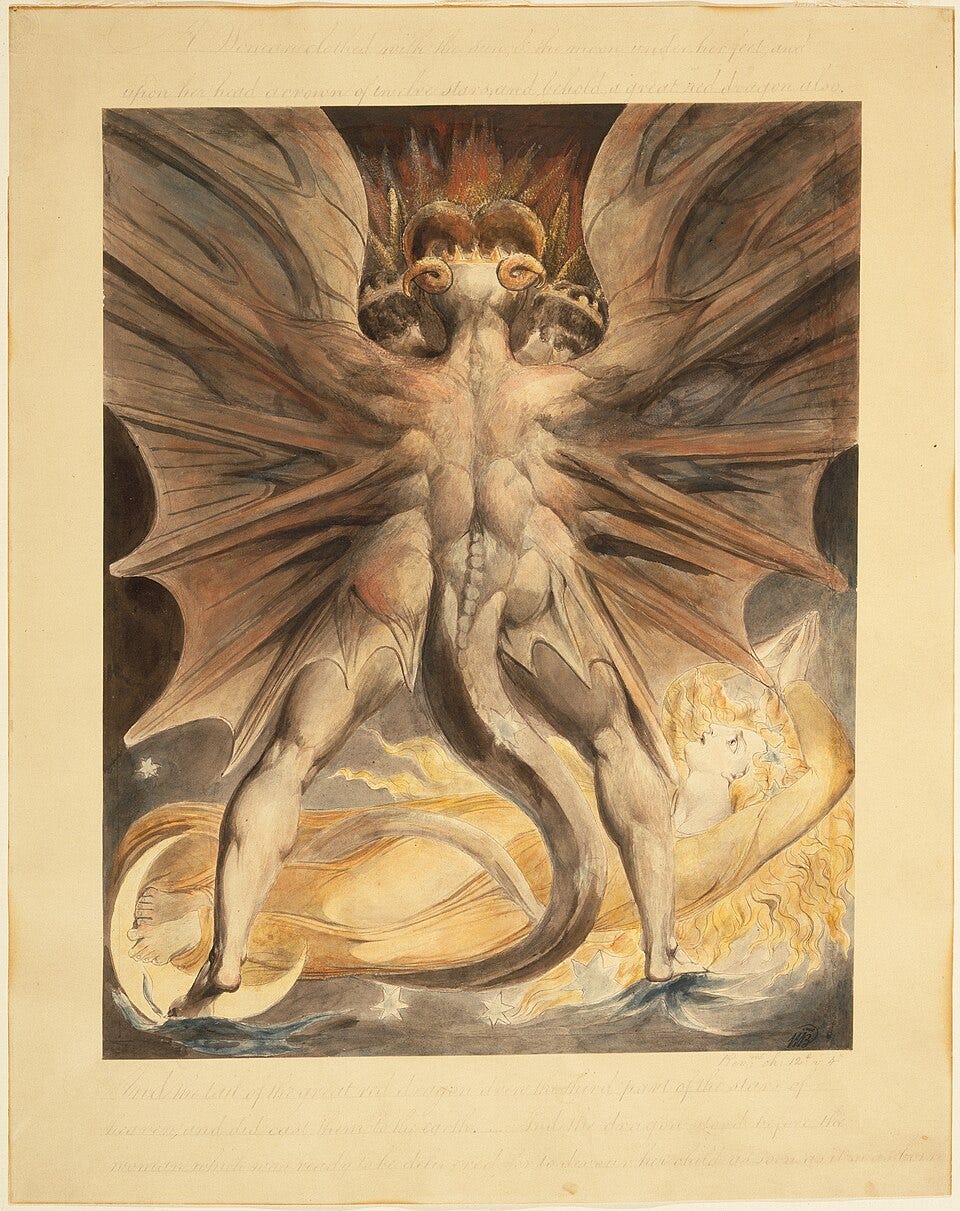
The psychology behind this transformation is interesting. He picks his targets by watching home movies that he edits in his job as a film processing technician. One can gather that by seeing these happy families experiencing the fullness of life—a kind of happiness and joy that he was denied in his abusive childhood—something in him grows hungry. Some deep part of him yearns for transformation—yearns to step into the fullness of his identity, which he sees as being handed down to him by the voices he hears, brought on by his schizophrenia.
It’s an extreme case of mental illness and its effects are horrifying, but there’s something to be learned here. Like Thorin in The Hobbit and like Dolarhyde’s successor, Buffalo Bill in The Silence of the Lambs, the killer’s own inner dragon is fed by covetousness. He covets something that he was denied, and in trying to reclaim it in such a destructive manner, he effectively destroys it.
We become our own dragons—and often society’s dragons—when the thing we want poisons us into hating the people who already have it. We become dragons when we want something so bad that we try to consume it but in that consumptive act, it begins to consume us instead.
In Christianity, we have a saying that you love your family best when you love God the most. This might seem like an abrasive, even cult-like position to take but things might be more clear if we—for just one second—remove the word “God” from the equation and replace it with some rough equivalent like “The Highest Good.” I’m always hesitant to desacralize things in such a way, but here I think it might be helpful.
I know people who say that they’d do anything for their kids. Anything. They make their wife and/or children their ultimate sense of purpose and would sacrifice anything for them. This makes sense when you nobly keep that job you hate just so you can keep putting food on the table. Or you skip going out for beers with the boys so you can be there to tuck your kids into bed.
But what happens when you start sacrificing things like goodness to them, or truth, or beauty? What happens when you’re ready to twist reality itself towards them?
A good example of how this might play out is in Game of Thrones, where we see the Queen of the Seven Kingdoms, Cersei Lannister, prioritize her children above everything else. She lies for them, feeds their grandiosity, and has people murdered for them. She uses every ounce of her political influence to shape the world for them, sacrificing every modicum of truth, beauty, and goodness in the process, and by the end of the show (spoiler alert) every single one of her children is dead.
Whatever we make the Highest Possible Good, will bend reality towards it. And if it isn’t actually the Highest Possible Good, death and destruction will follow in its wake. You should care about your family. You should love your children. But you should not worship them. Children cannot handle the pressure of being gods. No mortal alive on Earth today can.
We should love things but we should love them in their proper order. We should not elevate people or material goods or career goals to the level of divinity. Only divinity can live in that realm.
In the Book of Matthew, when a Pharisee is trying to catch Jesus in a linguistic, legalistic trap, Jesus says:
“‘Love the Lord your God with all your heart and with all your soul and with all your mind. This is the first and greatest commandment. And the second is like it: ‘Love your neighbor as yourself.’ All the Law and the Prophets hang on these two commandments.”
Matthew 22:36-40 NIV
What’s interesting is that Christ gives two answers instead of one. The Pharisee only asked for one:
“Teacher, which is the greatest commandment in the Law?”
Matthew 22:36 NIV
It would have been easy for Christ to simply say “Love the Lord your God,” but instead he adds “Love your neighbor as yourself.” This combination of loving God and loving people reinforces a pattern that we see all throughout scripture, and that is the pattern of the sacred intersecting with the profane, of the vertical (divine) intersecting with the horizontal (humanity)—an image that is not-so-coincidentally manifested in the Cross—and of principle overlapping with practice.
It’s when the lower forms of this divinity (the lesser things we worship as the ultimate good) intersect with the material world that things go wrong. Loving your family above all things sounds good in principle but is something altogether different when it comes to practice, at best producing children with a skewed sense of reality and at worst, creating narcissistic monsters who think the world revolves around them.
It’s Francis Dolarhyde’s disordered love for a childhood he never had that turns him into a dragon and blows up the world around him. He’s like a stalker who—while pining after a girl he’ll never have—sees her happy with someone else and is driven insane to the point where he kills her, kills her partner, and then kills himself.
Again, this is an extreme example but the pattern plays out a million times a day in smaller, more insidious ways. For example, if I have some hyper-idealized version in my head of who I think my wife should be and focus on nothing but that, then I’ll miss the person she actually is and demolish my marriage in the process.
I’m not going to go so far as to say that right now everyone should immediately close this post and go convert to Christianity (unless that suddenly seems like a good idea to you) but I’ll say this: take stock of the things you prioritize in your life. Think about the things you sacrifice to them. Take a sober look at what it’s doing to you and the people around you. And then maybe wonder if there isn’t some higher Ultimate Good you can set your sights on.