
Creating the Dragon
Dragons and Rumors of Dragons #7

Now that we’ve taken a look at ourselves and have considered how we might accidentally turn ourselves into dragons, we can look outward to see how we might turn others towards such destructive ends.
One of the all-time classic examples of this in fiction is Mary Shelley’s Frankenstein, where an ambitious young scientist thinks he can twist reality and create life by animating dead flesh. He goes and digs up a bunch of corpses, hacks pieces off of them, stitches the pieces together, and then floods the mass of flesh with the spark of life.
Already, we can see a disordered pattern of creation. An image crystallized even further in the movie version that has lightning striking down from above to animate the mass of dead flesh lying in a horizontal position below. Life from above flows out into the material Dr. Frankenstein has gathered, but there’s something wrong.
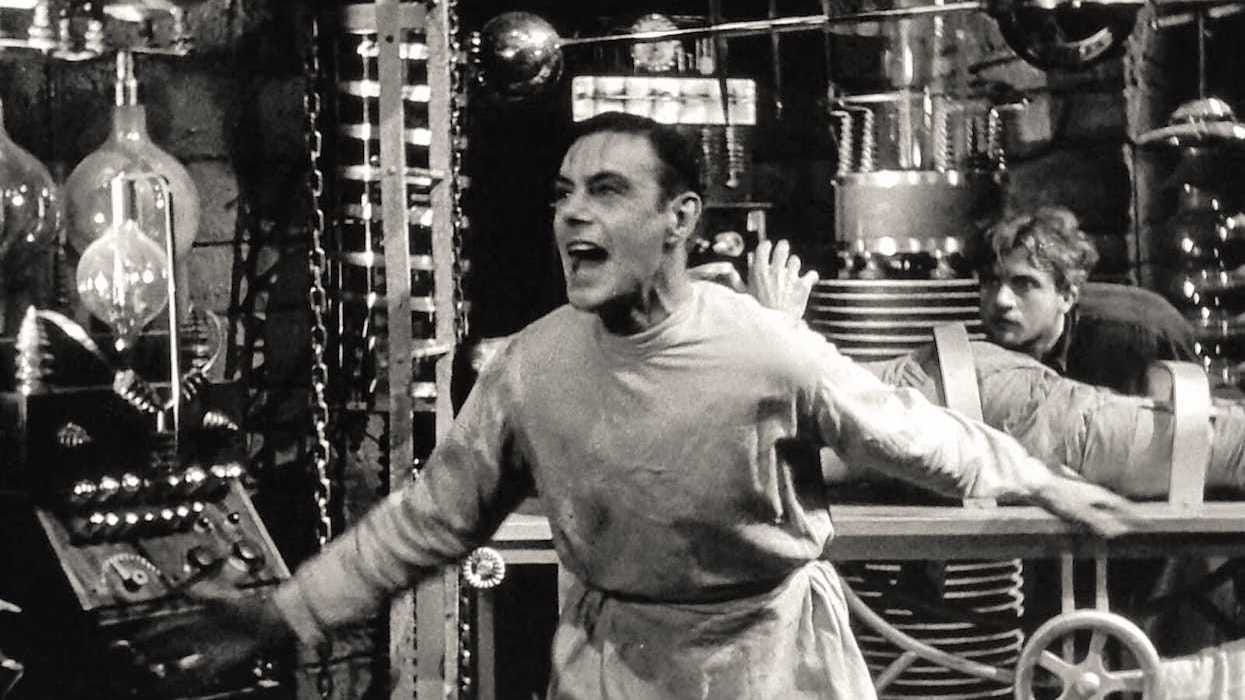
A lot has been made in the past about how people erroneously call the monster in the book “Frankenstein,” when Frankenstein is actually the name of the doctor and not his towering, wrathful creation. But I’d like to posit that it is in fact the doctor who is the monster of the novel and not the thing he creates. The thing he creates is a monster, to be sure, complete with the hybridity aspect we’ve talked about being a key indicator of a dragon, except this time it isn’t an amalgamation of different beasts as much as it is deceased individuals who have been stapled together. But the real monster here is Doctor Frankenstein.
Like all of us in our disordered desires, Frankenstein wanted to create something beautiful, but as soon as his creation breathes its first breath and opens its eyes to the world, the doctor realizes that he has not created an angel but a demon. The thing is horrid to look upon, reflecting back all of the doctor’s scientific hubris in its lurching, monstrous glory, and it’s this fearsome physical appearance that eventually drags the monster down into true villain-hood.
Townspeople scream when they see him. Acts of kindness are immediately forgotten upon the revelation of his monstrous form. And if it takes a village to raise a child, then Shelley’s monster immediately makes it evident that it takes a village to twist one into a monster. Like Francis Dollarhyde and other similar monsters, Frankenstein’s creation isn’t born evil but is twisted within his environment.
Another book that shows the same process in chilling detail is Cormac McCarthy’s Child of God, which revolves around a young man named Lester Ballard as he is abandoned by his mother and then suffers the loss of his father to suicide. Consequentially, he is ejected out into a cold world where the surrounding community wants nothing to do with him. As the book progresses, we watch as Ballard falls deeper and deeper down the well of depravity as he robs and murders his way across the Appalachian countryside.
There is a part in the novel where we see Ballard wearing the clothes of his victims in a way that echoes the dead that Frankenstein’s monster is stitched together out of. In the same way, Lester Ballard is composed of the dead. His history and identity is rooted in his own victimhood at the cruel hands of an uncaring world. And when we look at him, the stark horror of his creation is enough to make one shudder.
“He’d long been wearing the underclothes of his female victims but now he took to appearing in their outerwear as well. A gothic doll in illfit clothes, its carmine mouth floating detached and bright in the white landscape.”
-Cormac McCarthy, Child of God
The book’s title, Child of God, has a lot of implications to it. One interpretation of it might be that it dares to ask if this lowly creature still bears the image of God as is described in the Book of Genesis.1 Furthermore, it may be asserting that these are the kind of horrid things God creates. And finally, it asks what we—the gods that create the world around us—make with our own hands.
If God creates man, then what fearsome dragons might man create when he makes himself God?
This last question is explored thoroughly in Ridley Scott’s prequels to the Alien franchise, Prometheus and Alien: Covenant. While not being great movies (by my estimation), they do manage to cut to the heart of the issue.
In Prometheus, we get a creation story of sorts that sees the Engineers, large albino aliens with the ability to create life, seeding the planet Earth. Fast forward to a point in the near future, and a crew of explorers commissioned by Peter Weyland, owner of the Weyland Corporation we see a later iteration of in the Alien movies, sets out to explore a distant planet in search of the Engineers.
When they arrive on the planet, however, things predictably go south and we eventually learn that, for reasons that aren’t explained (in the movie at least), the Engineers sought to return to Earth and wipe out humanity. In a twist strangely reminiscent of Shelley’s Frankenstein, we suddenly find ourselves to be the ugly monster scornful of its creator.
What’s more is that the crew of the Prometheus has also brought along its latest and most advanced synthetic droid named David, complete with artificial intelligence. As the story progresses, we get very much the same feeling that our own creation has grown to hate us as well as we see David slowly turn against his masters and seed them with a biological weapon.
In the sequel to Prometheus, Alien: Covenant, we go a step further. If Prometheus simultaneously asks: “What if we’re the monster Dr. Frankenstein created?” and “What monsters are we currently making in the form of AI?” then Alien: Covenant asks: what monsters do those monsters create? About the time we reach the halfway point in the film, we are reintroduced to the android, David, through the eyes of another space crew, this one hoping to settle some distant planet. Once again, things go awry, and we eventually learn that the titular Alien featured in Ridley Scott’s 1979 classic was created by none other than David himself.2
On a personal level, I’ve always felt that this narrative turn goes too far in demystifying the monster from Alien and its sequels. And when I watch the original films, I go so far as to pretend that Prometheus and Covenant don’t exist, choosing instead to revel in the unexplained mystery of the creature’s origins. Furthermore, I think the character decisions and overall plot of the two prequel films are bumbling and riddled with holes, but I digress.
All that being said, the films probe this issue of creation better than most. And while I find movies like James Cameron’s The Terminator to be a better constructed and tighter film from a technical standpoint, I think Prometheus and Covenant offer a smarter glimpse into the impending world of artificial intelligence.
AI is a big topic right now and a lot of people are afraid of a scenario akin to that of The Terminator or The Matrix, where the machines break free of their bonds and try to either enslave or exterminate us. While I don’t think that this is completely outside of the realm of possibility, Ridley Scott raises a different issue. Instead of asking “What if machines try to wipe us out?” Scott goes a step further and asks “If we created AI, then what will AI create?” His answer, in so far as Prometheus and Alien: Covenant is concerned, isn’t pretty.
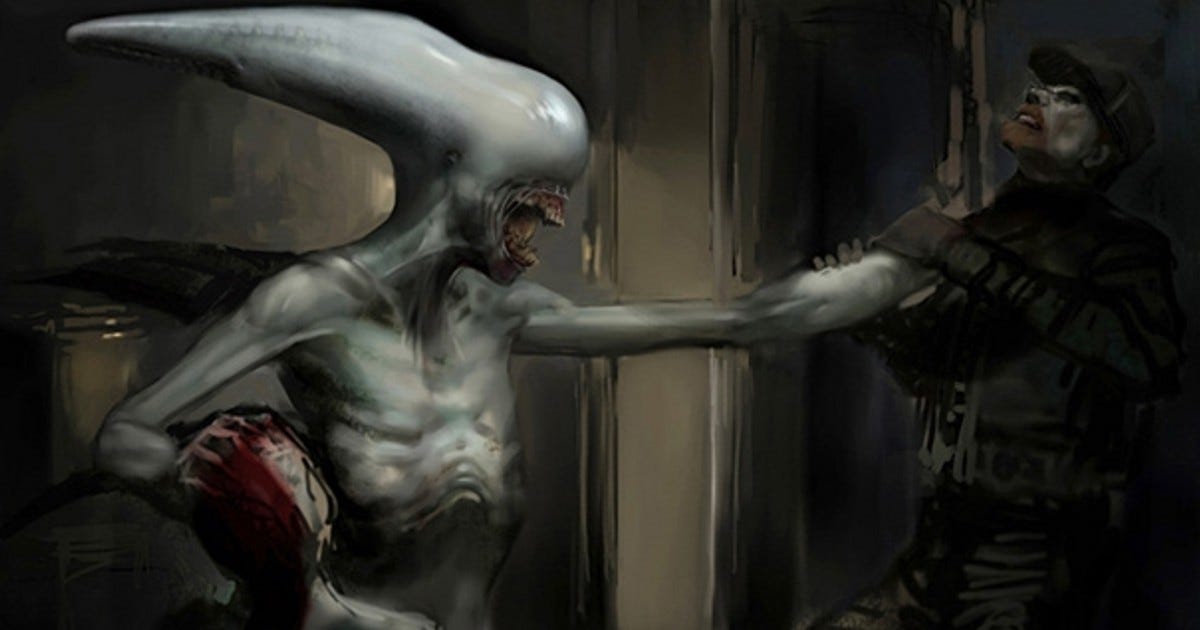
There’s a part in the original Alien film where another synthetic human named Ash gives a short monologue praising the monster’s construction. He says:
“You still don’t understand what you’re dealing with, do you? The perfect organism. Its structural perfection is matched only by its hostility.”
-Alien (1979)
Then, after one of the crew members asks if he admires it, Ash responds:
“I admire its purity. A survivor... unclouded by conscience, remorse, or delusions of morality.”
-Alien (1979)
When considering the question of what artificial intelligence might create, this answer is chilling. Since its first appearance in 1979, the alien has always given off a kind of biomechanical feel, as if it was created by some distant race rather than a naturally occurring animal. And if the dragons of the past are hybrids of creatures like snakes and cats, then the dragons of the future are hybrids of beast and machine. Cold, uncaring, and always hungry.
What we see in the xenomorph is an unflinching look at what a culture that prioritizes efficiency above all else might give birth to.
Some people like philologist Deacon Seraphim Rohlin, have pointed out the multiple strands of connective tissue between Alien and Beowulf.
One throughline is that we get another manifestation of the Devouring Mother and just like in Beowulf, this iteration (being the xenomorph queen) takes the title literally. There’s also the fact that in old Germanic myth (which was a clear influence on the epic poem), the master of technology, Wayland the Smith, bears a striking resemblance to that of the masters of technology in the Alien franchise, the infamous Weyland-Yutani Corporation. It’s also interesting to note that all of Beowulf’s swords either melt or break when coming in contact with his demonic foes, an image that seems to be reinterpreted in way of the xenomorph’s acid blood. And finally, the first time we see the alien’s grisly birth, it literally erupts from the chest of a man named Kane, harkening all the way back to this idea of the Grendelkin being descendants of the biblical Cain.
So what do all of these connections mean? What kind of thematic overlap is there between a 6th-century Old English poem and a 1979 sci-fi horror movie? Well, there’s a lot actually.
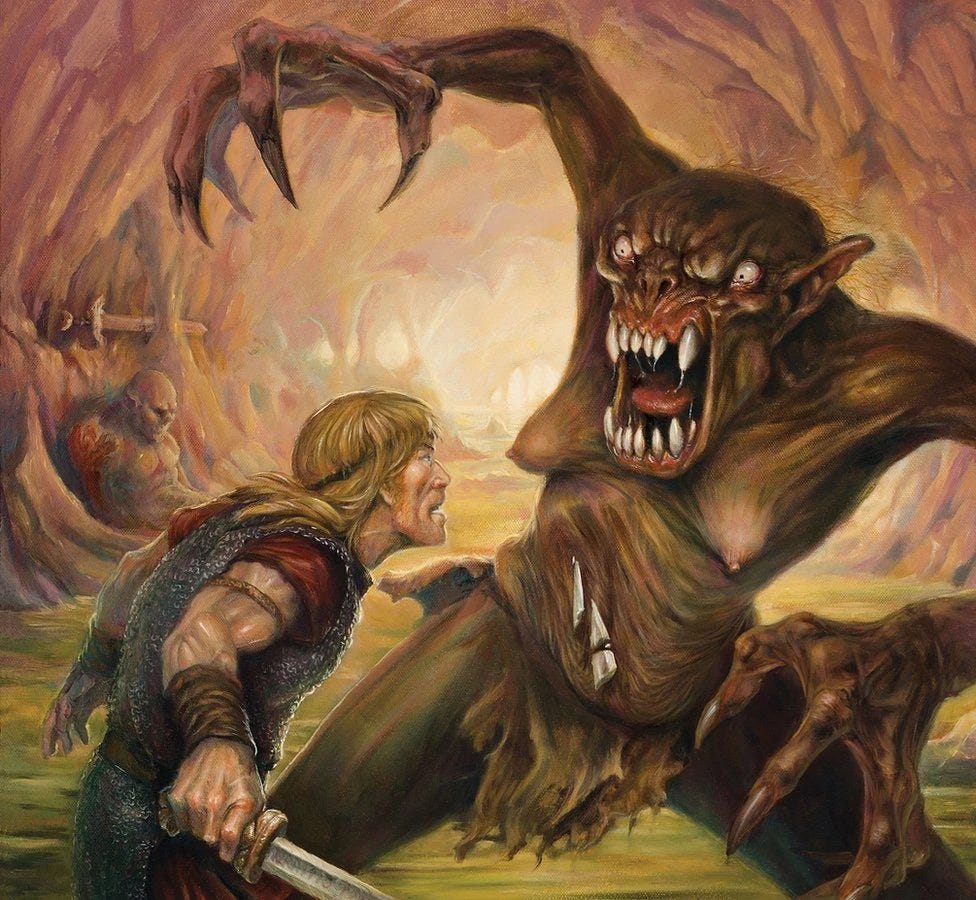
First of all, we get this creature on the edge of civilization coming in to devour people, an image that’s driven home by the fact that the first chest-bursting scene in Alien takes place in the ship’s dining room, echoing this disruption of the celebrations in the mead hall that we see in Beowulf. But the stories are deeper than just dragons on the edge. There’s also this theme of demonic forms of technology, a theme that is really only elucidated by a biblical reading of Beowulf.
The theme of the Children of Cain is clear in the old epic poem, as it’s explicitly stated. But the connections to old biblical literature are greater than this single allusion. Descriptions of the mere in which Grendel’s mother lives are startlingly similar to that of St. Paul’s vision of Hell in the Blickling Homily XVII. Grendel isn’t just described as a monster but as a “powerful demon.”
Today we think of disembodied spirits seeking pliant hosts like the one from The Exorcist. And while I think the modern view of demons (at least in so far as horror media is concerned) is more-or-less biblically accurate, there’s a difference between this disembodied possessing form and the way that the Old English thought of it.
Back around the time that Beowulf was written, folks didn’t have access to what we now think of as the Bible, but rather a number of specific texts, such as the books of Job and Genesis. Most important to our current discussion, however, was the fact that they also likely had access to the apocryphal work, The Book of Enoch, which tells of demons, giants, and the many practices of fallen angels.
1 Enoch says this:
And it came to pass when the children of men had multiplied that in those days were born unto them beautiful and comely daughters. And the angels, the children of the heaven, saw and lusted after them, and said to one another: ‘Come, let us choose us wives from among the children of men and beget us children.’ And Semjaza, who was their leader, said unto them: ‘I fear ye will not indeed agree to do this deed, and I alone shall have to pay the penalty of a great sin.’ And they all answered him and said: ‘Let us all swear an oath, and all bind ourselves by mutual imprecations not to abandon this plan but to do this thing.’ Then sware they all together and bound themselves by mutual imprecations upon it. And they were in all two hundred; who descended in the days of Jared on the summit of Mount Hermon, and they called it Mount Hermon, because they had sworn and bound themselves by mutual imprecations upon it. And these are the names of their leaders: Samlazaz, their leader, Araklba, Rameel, Kokablel, Tamlel, Ramlel, Danel, Ezeqeel, Baraqijal, Asael, Armaros, Batarel, Ananel, Zaqiel, Samsapeel, Satarel, Turel, Jomjael, Sariel. These are their chiefs of tens.
And all the others together with them took unto themselves wives, and each chose for himself one, and they began to go in unto them and to defile themselves with them, and they taught them charms and enchantments, and the cutting of roots, and made them acquainted with plants. And they became pregnant, and they bare great giants, whose height was three thousand ells: Who consumed all the acquisitions of men. And when men could no longer sustain them, the giants turned against them and devoured mankind. And they began to sin against birds, and beasts, and reptiles, and fish, and to devour one another’s flesh, and drink the blood. Then the earth laid accusation against the lawless ones.1 Enoch 6-7
We see here that in ancient biblical tradition, demons weren’t just The Exorcist type demons but the spawn of fallen angels who had mated with human women, creating hybrids not of creatures or man and machine but of man and devil. These giants, sometimes known as Nephilim, were masters of technology that taught humans to create weapons of war and perform dark acts of magic.
So Grendel and his mother—and even the dragon that we see later on in the poem—are seen as descendants from this long line of demonic masters of magic and technology (the two concepts being regarded as the same thing in the ancient world). So looking both at the Alien franchise and Mary Shelley’s Frankenstein, we see how this dark use of technological prowess can be used to create the instruments of our own destruction.
And as we grapple with the implications of a world suddenly flooded with artificial intelligence—something we have only barely come to understand in concept—maybe we shouldn’t be viewing it through the lens of The Terminator but through the lens of Alien and Frankenstein. Instead of viewing our own creations as tools that have the potential to become sentient, perhaps we should already be treating them as sentient. Maybe we should be looking at it not like a wrench or power drill but like what it actually is: an amalgamation of disconnected consciousnesses, many of them from people long dead. A draconiform hybrid of our best intentions and worst impulses. As an already outcast person on the edge of human society, with the potentiality for great things so long as we do not finally look upon its face and turn away in disgust.
If this artificial construct is being taught to see the world in the same way we see it, through an ultimate aim or telos, then we’re going to have to teach it pursue something higher than just profit and cold-blooded efficiency, which is what it is being trained to pursue right now. Or else we risk the danger of creating something similar to that of the murderous android David from the Alien prequels, and if that happens, then who knows what kind of dragons might be lurking on our future horizon?
So God created mankind in his own image,
in the image of God he created them;
male and female he created them.
-Genesis 1:27
Though this revelation is later retconned by the franchise.
(There is a lot of crossover here with some of my own work, which I'll avoid articulating.)
This is a great summary of some primal anthropology when it comes to STORY. "The child who is not embraced by the village burns it down to feel its warmth." That's a really old idea.
In terms of the creator's creation, the real terror of the answer isn't even that the creation is "alien" (pun intended). The terrifying implication of singularity is that we are not capable of conceiving what something so computationally intelligent might possibly do. It would be as nonsensical as trying to explain this blog post to an ant. *Maybe* the ant, in sensing sound waves moving over it, might grasp that the sounds are coming from whatever it conceives a human being to be...with no comprehension whatsoever as to the meaning or content of the sound.
That's probably the best we could hope for, and if that's even close to an accurate metaphor for what a creation's creation would look like, then "terrifying" isn't the right word, but rather, "eldritch."
Good thoughts here!
DRM